


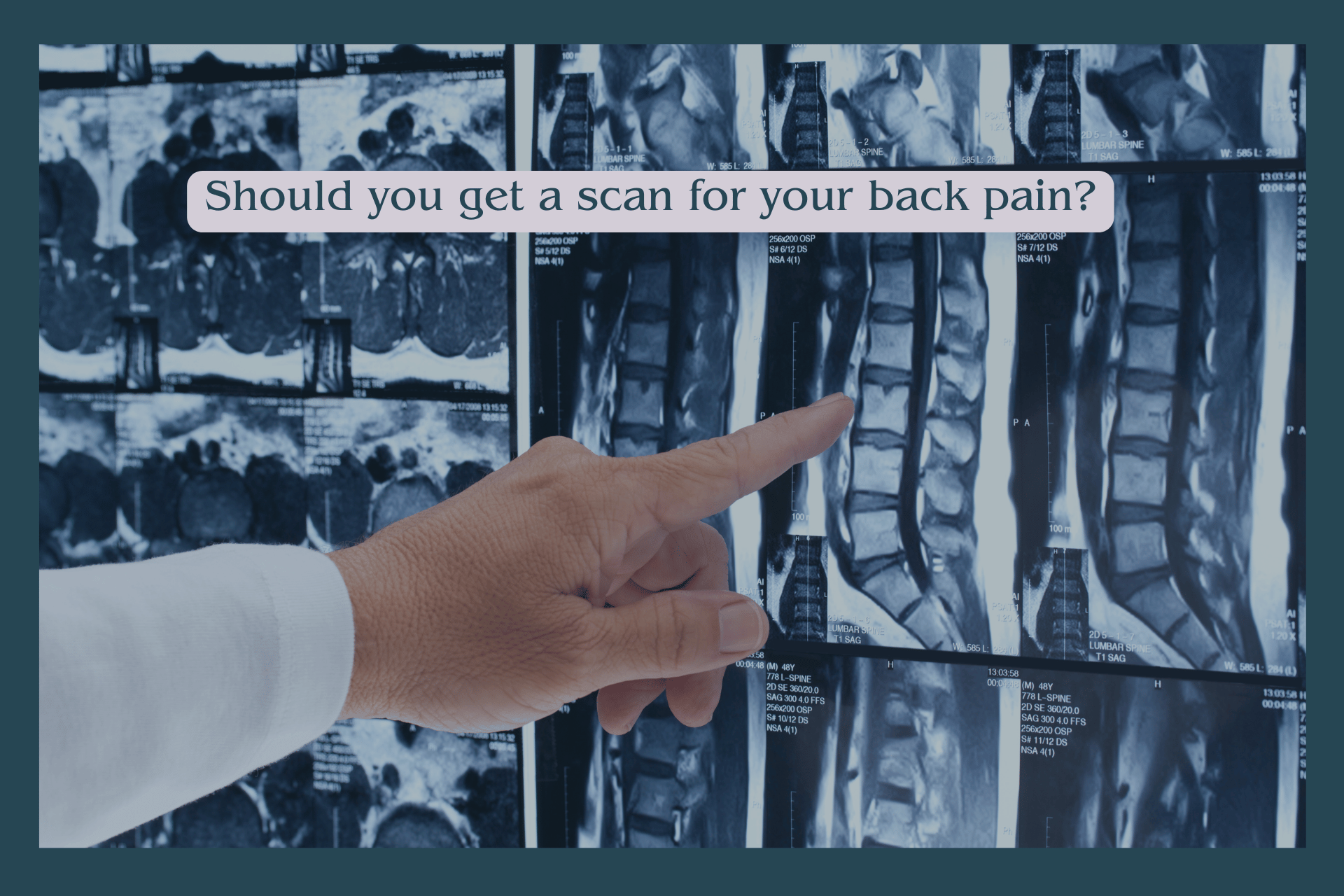
If you’ve been struggling with ongoing back pain, which is really impacting on your life, wellbeing and mental health, you may be wondering whether you should have a scan. Maybe the doctor has recommended this but the waiting list is too long and you are therefore considering paying private and wondering whether it is worth it. I hope this article helps to explain the pros and cons so you can make an informed decision. MRI, CT, and X-rays are often used to diagnose spinal issues, but are they always necessary? The answer isn’t as straightforward as you might think and therefore is it worth forking out the £100s to go private to speed up the process.
While scans can be incredibly insightful in certain situations, they can also lead to unintended consequences – like increased fear and worry about your condition. Given that chronic, neuroplastic pain is a result of the brain detecting danger and pain is as a protective mechanism, if we increase fear we can increase pain. I know this firsthand.
My experience: When a MRI created fear instead of clarity
Years ago, I had an MRI for my back pain. The results came back with the words “degenerative disc disease” which all sounds very scary especially when you tag disc and disease in the same sentence. This diagnosis hit me like a ton of bricks. My mind went into overdrive – I was too young for this (age 30); Was my spine fragile? Was this a life sentence for pain? I felt weak, fragile, scared and suddenly hyper aware of every movement I made.
Later I had another MRI for my neck (my pain had moved which I now know is a classic sign of neuroplastic pain), and this time the diagnosis was muscle spasm – something that couldn’t even be seen on the scan! That moment was a turning point. It made me realise that scans dont always provide the full picture, and sometimes, they can actually make things worse by fuelling fear. This is why I want to share the pros and cons of having a scan for back pain, so you can make an informed decision.
The Pros: When a Scan Can Be Helpful
✅ Ruling Out Serious Conditions
One of the biggest benefits of having a scan is that it can help rule out serious medical conditions, such as:
• Cauda Equina Syndrome (a medical emergency that requires immediate treatment)
• Fractures (from trauma or osteoporosis)
• Infections or tumors (rare, but important to diagnose)
If you’re experiencing red flag symptoms like loss of bladder or bowel control, severe leg weakness, or unexplained weight loss, a scan is absolutely necessary. Please seek medical treatment immediately.
✅ Providing Clarity in Some Cases
If your symptoms aren’t improving despite treatment or there’s concern about a structural issue, a scan might help guide the next steps.
✅ Peace of Mind (in Certain Cases)
Sometimes, knowing there’s nothing sinister going on can be reassuring. But as I learned the hard way, this can be a double-edged sword (more on that below!).
The Cons: When a Scan Might Do More Harm Than Good
❌ Scans Don’t Always Explain Pain
Remember that pain does not equal tissue damage and vice versa. One of the biggest misconceptions is that a scan will “find the problem” behind your pain. However, pain is much complicated that simply looking for a physical explanation. Many people have scary-looking scan results and NO pain at all! In fact 50% of 30 year olds show disc degeneration but have no pain. This is simply a sign of ageing. People can have bulging discs and disc protrusions and have no pain. This is like saying your wrinkles are causing your headaches! It’s called ageing. Arthritic changes may show up but might not actually cause discomfort. The problem is, consultants are trained to look at the bio-medical causes of pain, but chronic pain doesn’t not necessarily have a but-medical cause.
In my case, my MRI labeled me with degenerative disc disease, but what it didn’t show was the role of muscle tension, stress, emotions, and movement patterns —all of which played a much bigger role in my pain than the scan findings.
❌ The Fear Factor: Catastrophisation
Seeing terms like “degeneration” or “bulging discs” on a scan report can be terrifying—especially when no one explains that these are often normal, age-related changes. The language used by doctors and consultants can contribute to our fear, triggering the danger response in our brains which is – increase pain and muscle tension to protect. Lorimer Moseley calls these “Danger in Me or DIMS”. If we have more DIMS than SIMS (Safety in Me) then we experience pain.
When I got my diagnosis, I started to fear movement, thinking I’d make my condition worse. That fear actually made my pain worse by increasing muscle tension and reducing my confidence in my body’s strength. This is called catastrophisation, and it’s something many people experience after a scan.
❌ Unnecessary Medical Interventions
If a scan finds something abnormal, it might lead to unnecessary treatments—like injections or surgery that may not be needed. Many times, conservative treatments (like movement, strengthening, and mindset shifts) and of course my BEAT pain program are far more effective.
So… Should you have a scan?
Yes if:
✅ You have red flag symptoms (e.g., bladder/bowel issues, severe weakness, night pain, unexplained weight loss).
✅ You’ve had a serious trauma (e.g., car accident, significant fall).
✅ Your pain is getting significantly worse despite treatment.
It may not be necessary if
❌ Your pain is mechanical and responds to movement and activity.
❌ You have no red flag symptoms, and your symptoms improve with time.
❌ You’re mainly seeking reassurance (since this can sometimes backfire).
❌ If your pain has lasted for more than 12 weeks and comes and goes for no apparent reason – chances are it is neuroplastic pain and can be treated using a conservative approach like the BEAT pain program.
The takeaway: A balanced approach
Scans can be incredibly valuable in the right circumstances, but they’re not always needed for common back pain. In fact over 90% of persistent back pain is not due to a structural cause. If you’re unsure, talk to a healthcare professional who understands the bigger picture—not just what the scan shows.
And most importantly—don’t let a scan define your pain or limit your potential for recovery. Your back is strong, adaptable, and designed to move!
I hope this helps – I do offer 30 minutes FREE consultations if you would like to know whether the BEAT pain program would be suitable for you or not. I’m not in this to sell you something that I know won’t be suitable and if I don’t think it is right for you, I will tell you and signpost you in a more suitable direction. But what I have found is that even with people on waiting lists for operations, the BEAT pain program has alleviated symptoms making their journey more pleasant. The good thing is there are no harmful side effects from doing the program. The side effects are: clients experience more energy, weight loss, better moods, and reduced pain! Not bad hey?
Receive fresh wellness content straight to your inbox
Explore more
Related Wellness Resources






Help for your Chronic Pain
B.E.A.T Pain: Your Personalised Wellness Journey
Introducing the BEAT Pain approach, Katie’s strategy designed to empower your journey to lasting pain relief.

Brain
Uncover the role of the brain in your pain experience, gaining insights that empower your journey to lasting relief.
Energy
Elevate your healing potential by delving into the importance of good nutrition and sleep, unlocking vital sources of energy for your recovery.
Activity
Discover the transformative power of movement as we help you understand the pivotal role activity has on your path to recovery.
Therapy
Embark on a personalised healing journey with an array of therapeutic offerings, each designed to complement and support your unique chronic pain journey.
